Wed February 15 2006
Mossberg on backing up phone contacts
|
|
01:59 PM by Alexander Turcic in Miscellaneous | Lounge
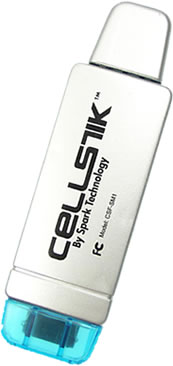
Overall, CellStik is a fast and simple solution that could save users from the frustrating ordeal of losing a cellphone and every name and number on it. Its independence from phone carriers and from your PC -- if you so choose -- make it a smart buy, but check first to be sure it's available for your phone. And keep a lookout for photos that might be mismatched with incoming calls. |
|
[ 1 reply ] |
Minimo CE 0.13rc1 released
|
|
04:32 AM by Alexander Turcic in Archive | Handhelds and Smartphones
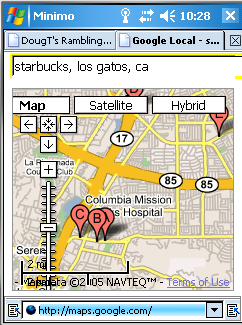
The latest version 0.13 includes a new UI, inital download support, better Windows Mobile SP 5.0 support, and lots of bug fixes. You can download the first release candidate from here. |
|
[ 0 replies ] |
Tue February 14 2006
Sunrise XP beta 1 released
|
|
05:54 PM by Laurens in Archive | Sunrise
Only some minor new things in this release:
To convert your existing Sunrise SDLs, select "File -> Open" from the main menu, choose "Sunrise SDL" as the file type and pick your SDL. Some SDL settings cannot be converted. Scripting, for instance, has been replaced by link rewriting rules based on regular expressions. I will post updated document settings for sites like BBC News, ESPN and Reuters on the sunrisexp.com site over the next few days. I think the product is stable enough to be labelled as beta. I'll attempt to fix any bugs that show up, but I won't be able to address every issue. The only feature that will be added during the beta phase is Help documentation. |
|
[ 3 replies ] |
More info about the new Access Linux Platform
|
|
02:35 PM by Bob Russell in Archive | Handhelds and Smartphones
Here are a few highlights: The approach is compared to Apple's OSX approach, which also supported multiple APIs, and went to a Linux core. The new MAX API has "a lot of user experience guidelines and libraries so developers can create easy-to-use software," according to Albert Chu, Vice President, Business Development at PalmSource. Chu also says that there are a lot of reasons to believe this will be adopted by device makers and much more successful than the failed Cobalt. "Unlike Cobalt, ALP was 'designed in response to market needs' and 'is the result of many people talking to the development managers as to what was needed; it's socialized in the industry ecosystem, because ACCESS has relations with handset people, manufacturers and operators.' " One would certainly expect that after the Cobalt experience, ACCESS and PalmSource would be especially careful to avoid another similar failure on a Linux-based platform. The only real negative was an astute observation by the PC Magazine writer, who noted that "Chu pointed to ALP endorsements from Freescale, Intel and NEC, but a notable absentee was PalmSource's number-one licensee, Palm." Hmmm. Maybe Palm, Inc. is too busy with that secret third business line that we heard about, but haven't yet seen. Or they may be waiting to see the product, and whether or not they can negotiate favorable licensing terms with Access before they stick their neck out and talk about endorsements. The extended wait until devices appear in 2007 at the earliest can feel like forever, and one might think that PalmSource will be so far behind that it can't catch up. However, despite cries of an ancient PalmOS Garnet (OS5), the devices built on it are still quite powerful and solid. Another year is not going to be what makes or breaks the future of PalmOS/ALP. There may be the inevitable drift of some PalmOS developers away to other platforms. And the wait may seem competitively damaging. But no company has the mobile device platform all figured out yet. What will determine the success or failure has much more to do with whether Access can produce a platform that is solid and capable, and whether it's popular with device makers. Regardless of what you may think about these short term delays, the mobile future is coming fast. Hold on tight because we're in for an exciting ride! |
|
[ 3 replies ] |
Study announced on the commercial use of e-paper
|
|
12:56 PM by Alexander Turcic in E-Book General | News
According to Jukka Kivinen, head of UPM's New Ventures unit, a larger pilot project on the commercial use of paper-like electronic displays will start in spring 2006. The company will not produce the basic technology of the displays, but will further develop the technology application. According to Kivinen and Jukka Enarvi, who is in charge of the project, electronic price displays in retail outlets are one of e-paper's first applications. The time for e-books will come later. UPM has previously demonstrated electronic paper at a Kesko Food's outlet in Helsinki (see attached images). [via eFinland] |
|
[ 1 reply ] |
ACCESS Linux Platform announced - but don't expect anything before 2007
|
|
06:07 AM by Alexander Turcic in Archive | Handhelds and Smartphones
"We believe that ALP combines best-in-class open source Linux components with proven mobile technologies developed by PalmSource and ACCESS' Linux expertise," said Toru Arakawa, president and CEO of ACCESS, Co., Ltd. "As a commercial-grade, flexible, open, robust and standards-based mobile Linux based platform, ALP is designed to provide handset manufacturers with faster time-to-market while supporting the goal of operators to offer revenue-generating services, applications and content." Details:
[via Palm Addict] |
|
[ 8 replies ] |
Unpaper 1.1 book scan post-processor
|
|
05:30 AM by Alexander Turcic in E-Book General | News
Unpaper tries to clean scanned images by removing dark edges that appeared through scanning or copying on areas outside the actual page content (e.g. dark areas between the left-hand-side and the right-hand-side of a double- sided book-page scan). The program also tries to detect disaligned centering and rotation of pages and will automatically straighten each page by rotating it to the correct angle. This process is called "deskewing". Sources can be downloaded from here. |
|
[ 3 replies ] |
Palm Addict Treo 650 musings
|
|
03:36 AM by Alexander Turcic in Archive | Handhelds and Smartphones
I think in the future we will all be using a Palm / PDA / Phone combination device I have no doubt. Ask me a year ago and I would have said no I will never use a Treo. The one lesson Sammy has been taught is that never say never if that makes sense I am happy with my Treo. So there you go my 7 week Treo report simply put the Treo brings us together and can apply to whatever Palm you use but in my case its the Treo 650 and to make the point this whole post was written on my 650 whilst listening to Hung Up, Madonna and Speed of Sound by Coldplay. |
|
[ 0 replies ] |


Losing a phone is bad enough, but losing your phone contacts could turn into a real nightmare. Mossberg
As always, I'm pleased to announce a new Sunrise XP release.
There's some good information on the next incarnation of PalmOS, called Access Linux Platform (ALP), available from a
UPM-Kymmene's New Ventures, the high-tech division of the Finnish forestry company, is going to invest in a large-scale research project on the commercial use of paper-like electronic displays. While there's a lot of hype around e-paper technologies, companies are still pretty much clueless about how to deliver digital content both so that it's profitable for the provider and suitable for the consumer (DRM is the keyword).
So you've a bunch of old-fashioned p-books and want to put them somehow on your PDA, Tablet PCs or e Ink device? Welcome to unpaper, an open-source post-processing tool for scanned sheets of paper, especially for book pages that have been scanned from previously created photocopies.
Palm Addict Sammy recalls in his
Latest E-Books