Wed November 28 2007
Google Maps beta for phones now shows your location without GPS
|
|
12:44 PM by Bob Russell in Archive | Handhelds and Smartphones
With the new beta of Google Maps, your phone can not only show you maps and directions, but it will also determine your location. Google calls it the "magical blue circle", and it's their way of showing you roughly where you are located based on the nearest cell towers. I'm going to wait for it to get out of beta before trying it, but it sounds like a great feature for mobile phone users. Read more at Google's mobile blog page. |
|
[ 6 replies ] |
Mon November 26 2007
NYT's Pogues on Kindle: 'Wow'
|
|
09:49 PM by Alexander Turcic in E-Book Readers | Amazon Kindle
Full review: Link Don't forget to visit the Kindle forums for more hands-on reports from our members. PS: Just discovered another great hands-on from our friends over at jkOnTheRun. |
|
[ 20 replies ] |
British novelist doesn't want a Kindle for Christmas
|
|
08:04 PM by Alexander Turcic in E-Book General | News
Mr. Wilson turns out to be one of the more visible literary figures in Britain. Do your kids use the Internet? Watch out. You may have just turned them into thieving mind-numbed sex-addicted little monsters. Paper children books to the rescue. Thanks to eagle-eyed Jorgen for the tip! (image courtesy of New York Times) |
|
[ 33 replies ] |
Sat November 24 2007
MobileRead Week in Review: 11/17 - 11/24
|
|
07:00 AM by Alexander Turcic in Miscellaneous | Week in Review Here are the highlights from the past seven days of MobileRead: E-books - News
E-book Devices - Bookeen Cybook Gen3 E-book Devices - Amazon Kindle |
Wed November 21 2007
PVI thinks big, also thanks to recent Kindle mania
|
|
11:42 AM by Alexander Turcic in E-Book General | News
The article also reaffirms what we've heard and stated several times before, namely that the next step on E Ink's roadmap is to further increase the level of grey scales and to introduce - hey, the guys do know how to make our wildest dreams come true! - color. Also, in a related article Digitimes reported about recent rumors according to which PVI in the progress of acquiring another LCD maker's product lines to expand capacities. [Thanks to Jae for the news!] |
|
[ 15 replies ] |
My review of the CyBook Gen3 e-reader
|
|
09:49 AM by tribble in More E-Book Readers | Bookeen
The reader itself is very lightweight and so very convenient to travel with. The leather case fits smoothly around the CyBook and offers good protection for the screen with the built-in strong frontplate. My Cover did not close properly at first. After using it a while, it started to close just fine. Other than that, its of very good quality. The design of the CyBook itself is far from perfect. While the size and weight are optimal for casual reading, the button layout is not very comfortable. The main button is not easily reached when reading with one hand, and it is difficult to hit the "next" button when holding the device in one hand. The buttons to the side of the CyBook are often accidentally pressed and leave you in the music folder or back in the library. I would prefer the secondary buttons at the top or bottom of the device, so they do not influence your reading experience. As for turning pages, the main button should be centered and there should be additional buttons to each side of the display to turn pages. Reading on the CyBook, it made me even more appreciate the flipbar button of the iRex iLiad. Turning pages on the CyBook leaves my thumb in an unnatural position and holding it this way can be quite uncomfortable. If the center button could be used to turn to the next page, it may at least fix the worst for me. The decision not to use a glossy casing was definitely the right one. Even the matte casing shows fingerprints and smudges very quickly, but you can clean it easily. The casing itself is not that firm. It is a bit loose and squeaky when you hold it. Especially on the left side of the casing, where the secondary buttons are located, the casing moves quite a bit, when putting your fingers around it. But overall the device seems well manufactured. In comparison, while the iLiad 1st generation had a similar squeakiness to it, the 2.0 is very firm and solid. So maybe the CyBook Gen3.1 will do the same. The mini-USB Port and audio socket at the bottom are covered by a little piece of rubber. Since the casing overlaps the mini-USB port, not every mini-USB cable fits. The rubber cover itself can get off quickly. I don't know, if it is really necessary and I guess that many of us will soon live without it. The battery lifetime is more than enough for most people. This might be a bit biased, since I have used the iLiad for so long and only got to use the Sony Reader for a very short period of time. With auto-shutdown turned off and firmware release 1.0, the CyBook's battery last for about five days. With auto-shutdown turned on, the lifetime extends to weeks for a normal reading person. Having a user replaceable battery is also a big plus. Since the CyBook can be charged via USB, it can also easily be charged with my Solio solar charger. I guess I will never run out of energy with that combination. The Software is the best I have seen on any E Ink reader so far (not having seen the Kindle in action yet). Even with its first release, Bookeen has most of what you could wish for for casual reading. For Mobipocket and text formats, the functions to change fonttype and fontsizes are easy to use and you can even add your own preferred fonts. Optionally, you can display a header with book information and the statusbar at the bottom. It would be great if one could also set margins; who knows, we may also see that in the future. The PDF viewer is sufficient for a small screen device, but it really needs to get a real zoom function in the future. Still, it's quite usable with custom-formatted PDFs such as those from Feedbooks.com. The library is nice to look at, and its great to see cover images of books. Now, it would be a great idea to see the position you are currently in a book as well. You can sort by book title, date and size. Unfortunately, all files from internal and external memory are displayed in the library. When you have hundreds of files on your card, you will definitely lose your orientation, since the CyBook does not support a folder structure. There is no search functionality either. Still, if you have let's say less than a hundred e-books loaded, it is very good to use. Not perfect, but the best library on an e-book device so far. At least in my opinion. One thing started to annoy me during my testing. The center button brings up the menu. It should better turn to the next page. Pressing the menu button twice should should close the menu again. Unfortunately, instead it starts on "Start reading" which brings you to the beginning of the book. The menu button is just too prominent and should be used for turning pages. I would like to see page numbers on Mobipocket files, since once you lost your place in a book, you have no way of knowing where you where before. Also, the pagebar is too prominent as an indicator (instead, make it a light gray) and not very informative. Since you don't have an idea on which page you are, the "go to page" menu can be a bit irritating. Really good is the speed. The CyBook is fast. It starts within around 22 seconds. Opening a book is fast, turning pages is fast, changing fonts is fast. That's where E Ink's Vizplex technology shows its strength. And so does the programming skill of Bookeen's programming team. They have done an excellent job so far, and I hope they will continue to support and advance the CyBook over the coming months. Now the bad part. Even though the device uses a Vizplex screen, I am quite disappointed in the display quality. Don't get me wrong, it is still amazing. But in comparison to the non-Vizplex display of the iLiad, it does not even look as good. While the display itself might be bit brighter than that of the iLiad, the iLiad is definitely clearer. The CyBook's display has little dark speckles on the white, and the black is not as dark as on the iLiad (white speckles includes). The fonts are not as crisp and the contrast is lower. It is not by much, but I can notice it (not even without some annoyance). So I guess I am spoiled. I do not know if I have a faulty display, or if the electronics, the display, or the software is responsible, but overall the display quality of my non-Vizplex iLiad is better than my Vizplex CyBook. When you want to buy the CyBook, I cannot recommend the Deluxe package. Get the standard package instead, and the leather cover. If you need an USB charger, buy it for 10 Euro somewhere else. Use your own SD card, and buy a new battery only when you need it. If you need more energy, get a Solarcharger or a battery pack, because you won't need to charge often. In conclusion, I do like the CyBook and I think it is a great alternative to the iLiad if you want a smaller, cheaper device with longer battery life. And not to give the wrong impression: The CyBook is a great reading device. It's a nice piece of hardware with even nicer software. There's surely still lots of room for improvement, but that's always the case with new technology. For me, the CyBook is the second-best e-reader on the market, right after the iLiad -- though it all depends on your needs. My wishes: Improve the layout of the CyBook and improve the software or the iLiad. |
|
[ 35 replies ] |
Aussies rejoice - e-book hardware on sale in this country
|
|
05:48 AM by Dajala in E-Book General | News
I'm really hoping 'European e-book reader' = the new Cybook Gen 3. However, the Dymocks CEO also says,
A dedicated ebook reader supporting MS Reader files would be a first as far as I know. SMH Artlicle is here |
|
[ 47 replies ] |
Mon November 19 2007
Amazon Kindle might be the worst thing that could happen to e-books?
|
|
02:20 PM by Bob Russell in E-Book Readers | Amazon Kindle
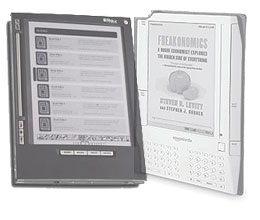
In almost every way, this looks like the revolution that e-book lovers have been waiting for. So how can I possibly wonder if this is the worst thing that could happen to e-books? I'll give you a hint... Amazon has gone out of their way to make sure that you can only buy books from them, and can't use them anywhere else. When you buy a book, you use it on the Kindle or you're out of luck. We're talking about control of content, with format and DRM lock-in as the tool of power. We're on the verge of a future for content that makes you buy the same thing over and over every time you have a new technology. If you don't want to think about this in more detail, I'd suggest you jump to the end. But in case some of you are interested fanatics, let's take a look at how DRM locks every purchased book into a particular device. Just imagine if every paper book you owned could only be read using a particular book light. If the light bulb burns out, you have to get a new DRM key from the company that sold you the book, or you can't read it anymore even though you have the book in your possession and you paid for it. That's what it's like with device-based DRM. There are gentler versions, but that's the core idea. If you want to read the e-book you purchased after you buy a new device you are at the mercy of the seller. Maybe they will allow you some small flexibility like allowing you to upgrade to another newer model of the device, or even use the same reading software on another device. But if you want to change to something else, you're probably out of luck. Want to keep reading the e-book? You have to buy it again! And again! And again! Is that the best future for e-books? Maybe for publishers (but that's up for debate as they may be cutting off their own arms by limiting the market this way), but definitely not the best scenario for customers. In fact, I'd say it's the worst result. Higher prices and basically all you will get is a book rental. You're only renting the e-book for the period of time you use a particular technology. And we know how fast technology changes. Then you have to lose the use of the e-book or buy it again. Doesn't sound too customer oriented. Now consider Amazon's plan for the Kindle as I understand it. As it stands now, it looks like you can read other formats on it, maybe requiring a conversion step. That's good. But if you want to buy a modern book for it, you had either find a non-DRM'd book seller like Baen Science Fiction or Steve Jordan Books, or you had better consider your book to be held hostage by your Kindle. You won't be reading it on your PDA. And you won't even be able to read your purchase of a DRM'd e-book from MobiPocket sellers. That seems to be an innocent statement at first - you can only read non-DRM'd MobiPocket format on the Kindle. But think about it. It's a power play. So like I said earlier, even though Amazon owns MobiPocket, Amazon has gone out of their way to make sure that every book you buy for the Kindle stays there, and that you can't buy anywhere else. If you buy the more common MobiPocket formatted (DRM'd) e-book, you can't read it on the Kindle. That's power for the seller. And it's trouble for the customer. Is there an alternative? Actually there are two other general roads to the future that give some additional benefits to the consumer. Booksellers are probably going to fight this unless they believe the benefits of a large market outweigh any apparent loss of control over the content. *) A generic shared DRM future Imagine if we have DRM controls on e-books, but you can buy one of the standard formats with a standard DRM protection. There are only a few different competing approaches. There is so much of a customer base that you have some comfort level that new technologies will also support some of the existing formats and DRM. That means you can probably buy books at multiple stores, and price competition should keep prices more reasonable (although the publishers still control pricing on particular titles, so competition is still somewhat limited). More importantly, it allows you to keep using your e-book even when technologies change. Someone is probably going to support the existing format on new devices and platforms. It's not perfect. Even such a format might end up being worthless 20 years from now, but it sure beats only being able to read a book on one particular device. Sony is supporting this incrementally better future by indicating its support and partnership with Adobe for ePub. Assuming they don't limit the DRM on e-books to the Sony Reader only, it allows the potential for multiple e-book sellers to sell for the Reader and it allows a purchased e-book to be read even if you don't always use a Sony Reader to read the book. In addition, they allow for several devices on an account to read a purchased book. That is also slightly better than limiting the book to a single device. (In fairness, the same might be true of the Kindle, I just don't know yet.) eReader format uses a credit card number (stored only as the hash value internally for safety and privacy reasons). The advantage of this is that you or your family members can read the book on any device that supports eReader software. Of course, that's the problem -- the device list is very limited. So what is the ideal answer for an e-book consumer? This might just be it... *) A DRM-less e-book future In this case, the consumer wins, and by making the consumer happy, publishers and writers get rich also due to the explosion of sales and renewed interest in reading. The danger is the potential for book copying to become so rampant that publishers and authors can't make money on books. The opportunity is for e-book sales to explode, and for consumers to buy an e-book and use it on whatever device they want to read it on, and to say goodbye to the nightmare of incompatible formats or general DRM problems. Your own version of the future with no DRM probably depends on whether you are a consumer or publisher, whether you believe most people are inherently honest, and whether or not you believe that consumers need to be encouraged or extorted. Maybe that's a bit harsh, but a future of DRM certainly has both elements of opportunity and fear, and I don't think anyone has the definitive answer of what is best or most fair. But the Amazon vision of the future apparently is not in the consumer's best interest. Kindle supplies a full e-book ecosystem, but it's a very closed ecosystem when it comes to purchased books. You want to buy a modern book? Buy it in Kindle format and you can only read it on a Kindle. Even worse, maybe you can only read it on your Kindle. So as I said, Amazon might just be the worst thing that can happen to e-books. The Kindle looks like a great device, so I hope I'm wrong. Let's give Amazon a chance to show us the future they are trying to shape. I really, really hope I'm wrong. But the early signs so far are ominous for the general public. E-book fans, hang on to your wallet... you might find it hemorrhaging content loss. |
|
[ 206 replies ] |


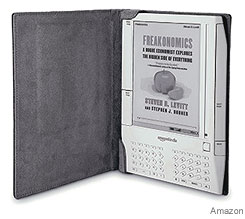
The famous tech journalist David Pogue of the New York Times has put in his official two cents about the Amazon Kindle. His verdict: the screen is "astonishing", Whispernet will "rock your world", and instant book downloading is a bliss. But the device design... needs improvement. David Pogue says:
Well, really, who is going to complain given the
It's been a banner year for e-book lovers, with several dedicated reading devices entering the market (Sony Reader PRS-505, Cybook Gen3, and last but not least our long-prophesied Amazon Kindle). Less commonly known perhaps is the fact that
I had a couple of days to play around with the new Bookeen CyBook Gen3. I have to say, I really like the device.
And in about six to twelve months we'll will compare those readers against the upcoming new flexible A4 devices.
Latest E-Books