


Thu April 27 2006
 Is Palm OS losing its Mojo? Is Palm OS losing its Mojo?
|
|
10:10 AM by Alexander Turcic in Archive | Handhelds and Smartphones
"They've been stuck at (Palm OS Garnet) for two-plus years. It's a pretty ancient operating system that can't handle multitasking, can't handle protected memory, and doesn't have great security, all the things that Cobalt was supposed to deliver," Gartner analyst Todd Kort said. Protected memory helps prevent applications from crashing the entire device, and Cobalt was supposed to have built-in support for authentication frameworks that would allow VPN (virtual private network) connections. Related: Why PalmSource May Be Right About Multitasking, Credible hints that Palm Inc is planning a new generation of Linux devices, What Palm Inc's Linux OS might look like [via Palm Addicts] |
|
[ 10 replies ] |
 Palm lovers, get out your hankies. According to
 |
A library location that might not be safe for e-book readers
|
|
10:03 AM by Bob Russell in Miscellaneous | Lounge
At Wylum library in the UK, they have decided to try a new approach altogether. They have proposed to move the library to the pubs! Yes, you read that right. According to the Hexham Courant, consultants are reported to have suggested "that books could be delivered to pubs and shops as an alternative to keeping Wylam Library open..." It has caused some outrage, understandably. But my primary concern is whether or not they are creating a "spill-free" zone to keep it safe for e-book reader devices! Via LISNews. |
|
[ 1 reply ] |
 Libraries are having a tough time these days. People have other ways of getting books, attendance is down, and most importantly the government budgets are really tight when it comes to library funding. So after you've done the fund raising, and belt tightening, and maybe even tried adding to your audio/video collections and community events, what's left to do?
|
Scholarly publications better in electronic form
|
|
09:48 AM by Bob Russell in E-Book General | News
So the question raised back in 2000 by David Goodman of the Princeton University Biology Library is whether or not the library should continue to keep bound paper copies of their journals. In fact, he even goes further and asked what journals should even be physically printed. The presentation has just recently been made available to us, and is pretty interesting. Due to the special nature of scientific research activities, he makes the remarkable (for 2000) statement, "Rather than considering whether e-journals are desirable or not, I am assuming they are generally preferable, and am considering whether the basic mode of production for almost all scholarly scientific journals is to be electronic only, except for special purposes or temporary accommodation." For more of this peek into the academic world of electronic content, visit dLIST. |
|
[ 29 replies ] |
 Got your thinking cap on, and ready to be an "academic" for a moment? Well, if you are looking for content in professional journals, you probably know by now that it's all about the availability and searchability. But not completely, because it's also nice to hold reasearch papers in your hands. Something about the personal contact and easy to read pages that's nice when you are going to spend that much time with a document. Unless you are really a whiz, and you can read the average professional journal in less than 10 minutes. Somehow, I don't even think Nobel prize winners do that.
Wed April 26 2006
|
Wampad gateway to mobile web
|
|
03:31 PM by Bob Russell in Archive | Mobile Sites
The author's description is that "It's basically a jump off point to alot of what the mobile web has to offer. You can enter in a search query once and use it to check google, yahoo or msn. You can also do some comparision shopping by entering in a UPC code and then check it against froogle, yahoo, beyond and amazon. There are about 18 contextual searches / direct info retrival that you can do using a pick list and a text box." Well worth a try at http://wampad.com/. Related links:
From Shawn McCollum, the author of this nifty tool. |
|
[ 0 replies ] |
 There's a new mobile site called Wampad that's an interesting starting point to all kinds of mobile web sites, news and information. It's designed specifically for mobile browsers. With just a quick initial look I found a nicely formatted list of Google news on various topics, and a simple interface to the IMDB movie database. If you choose a web site, it even gives you a "mobilized" version of the web site.
|
Presentation on iRex iLiad trial with more photos
|
|
02:58 PM by Alexander Turcic in More E-Book Readers | iRex
If you dig some further on the same site, you can find two basic tutorials (both in PDF) on how to use the iRex device. We extracted some photos for you and attached them to this post. |
|
[ 11 replies ] |
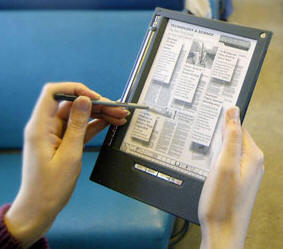 Thanks to an anonymous tipster for pointing us at a recent PowerPoint
 |
Free tool to convert DVDs for handheld viewing
|
|
02:08 PM by Bob Russell in Archive | Portable Audio/Video
But free tools are always very popular, so here's one more free option I hadn't heard about before - SOMPY Movie Encoder. "Watch movies on all kinds of devices including Pocket PC, Palm, Smartphone, Portable Media Center. Have fun on the go. It's so convenient to put your favorite movie, TV show in pocket and watch them anywhere, anytime. This software provides you a easy to use interface to convert video files(wmv, rm, rmvb, avi, mpeg, mpg, Tivo2Go, etc) or DVD(*.vob) into small size portable format(avi) playable on your device." Via Pocket PC Thoughts. |
|
[ 0 replies ] |
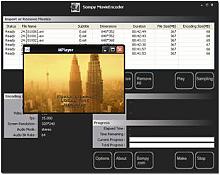 If you've searched for video conversion tools that allow you to prepare a video file for your handheld, you probably know that there are a lot of choices.
 |
Prison Break heads to cells instead of TV
|
|
01:35 PM by Bob Russell in Miscellaneous | Lounge
Personally, I love the show. A certain site administrator at MobileRead put me on to it, and I'm hooked. I'd be a good target market for additional content from them. But like most people, I don't like giving money to the phone company for content. Interesting note is that "...this is not the first time Fox has answered the mobile phone call, having already given action fans their weekly dose of pocketsize drama with the first-ever scripted mobisode series, 24: Conspiracy..." That's another show I'd love to see more of, but I don't know about the whole cell-sized drama thing. I think I'll stick to the supplemental Alias books. I hear they're aimed at teens, but hey, I love the show and the books are fun also! By the way, lest anyone become confused by the title, it's the supplemental content for Prison Break that's headed to cell phones, not the main show. You will still be able to see it on TV as always! |
|
[ 1 reply ] |
 I'm not going to pretend I understand this completely, but
|
Is mobile device adoption being held up by security concerns?
|
|
01:26 PM by Bob Russell in Miscellaneous | Lounge
Then we hear that people don't want the complication of a phone that does more than just phone calls. Whoops, not so fast! A recent survey says people love the extra features. In fact, they want more. And we are seeing all kinds of new devices coming up, such as special ESPN phones, video camera phones, music phones, etc. What are we to think about our beloved high-powered combination handheld devices? Talk to some and the future is full desktop power in something like an OQO or an Origami device. Let's look at the business side. We heard that the Treo was going to be hot with business customers once Palm adopted Windows Mobile along side PalmOS. Microsoft is much more palitable for businesses we hear. RIM was pretty much in trouble. No wait, they resolved their legal problems and they're back again, aren't they? As Michael Mace has said so elequently, we're not very good at predicting the future of mobile technology over the long run. We get close with our predictions 5 years out, but more than that and you can pretty much forget it. We end up talking about possibilities more than predictions. And earlier this month we saw the news that really started me thinking - Security Fears Hamper Mobile Devices, which based on a new survey, says "Around 60 percent of businesses are shying away from deploying mobile devices primarily due to security concerns." But businesses are afraid of the security risks of camera phones, iPods and thumbdrives also. And we don't see their adoption hampered by security threats! I think it's a factor, but I don't thing it's the problem. I'm starting to believe we can't see the forest for the trees. So let's take a step back and look at a few simple observations about the big picture. I think you'll find it interesting.
Now rather than come up with my own conclusions, I'd be interested to hear what you think this all means about whether mobile devices are going to be popular, what sorts of capabilities they will have, and what it will take to see the average businessman and businesswoman (or the average joe on the street) using a multipurpose and powerful computing device that fits in their pocket. And I wonder. If we do believe it's coming, then will it be an overnight jump like we imagine the iPod success to be, or will it be a progressive adoption like the way phones made it into our homes (and then pockets) in the first place? And come to think of it, why don't we think of other technology adoptions such as VCRs, CDs, TVs, cell phones, computers, etc to be overnight like the iPod? Has Apple marketing pulled another fast one on us?! Let us know what you think. Nobody seems to have these topics nailed down yet, so it's fun to speculate. |
|
[ 1 reply ] |
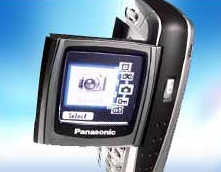 While this isn't exactly breaking news, one has to wonder why we hear such differing views of the spread of mobile devices. First we hear that the future of mobile computing is cell phones, and everyone will have a smart phone. We hear that internet usage on cell phones will outpace desktop internet usage.
  Week's Hot Topics
 Latest Polls
 Latest E-Books


 Latest Forum Activity
